Part III: Worked Scenarios
Chapter 15: Worked Scenarios
Each scenario is reasoned in the method Part I builds: establish the visibility state, then the defined states of the vessels, then the governing section and Rule, with Rule 2 held in reserve. Every scenario carries a situation diagram; amber is the vessel that must act, blue the vessel that holds, grey a vessel with no role yet. The set runs from the baseline encounter to the harder boundary cases and the naval ones, and is open-ended, more will be added as they prove useful. Distances given are illustrative, not thresholds (Chapter 8).
1: Classic crossing (baseline)
Clear weather; two power-driven vessels, A and B, on steady crossing bearings, B fine on A’s starboard bow, range closing on a constant bearing. Visibility state: in sight, so Section II. Defined states: two power-driven vessels. Governing Rule: Rule 15 crossing. B is on A’s starboard side, so A is the give-way vessel and B the stand-on. A takes early and substantial action (Rules 16, 8), altering boldly to starboard to pass under B’s stern; B keeps her course and speed (Rule 17(a)(i)).
PRACTICAL NOTE: why starboard? A’s turn to starboard takes her astern of B, satisfying Rule 15’s preference not to cross ahead, and opens the bearing rate so the manoeuvre is obvious on B’s radar. A turn to port would cut across B’s bow and breach the secondary obligation.
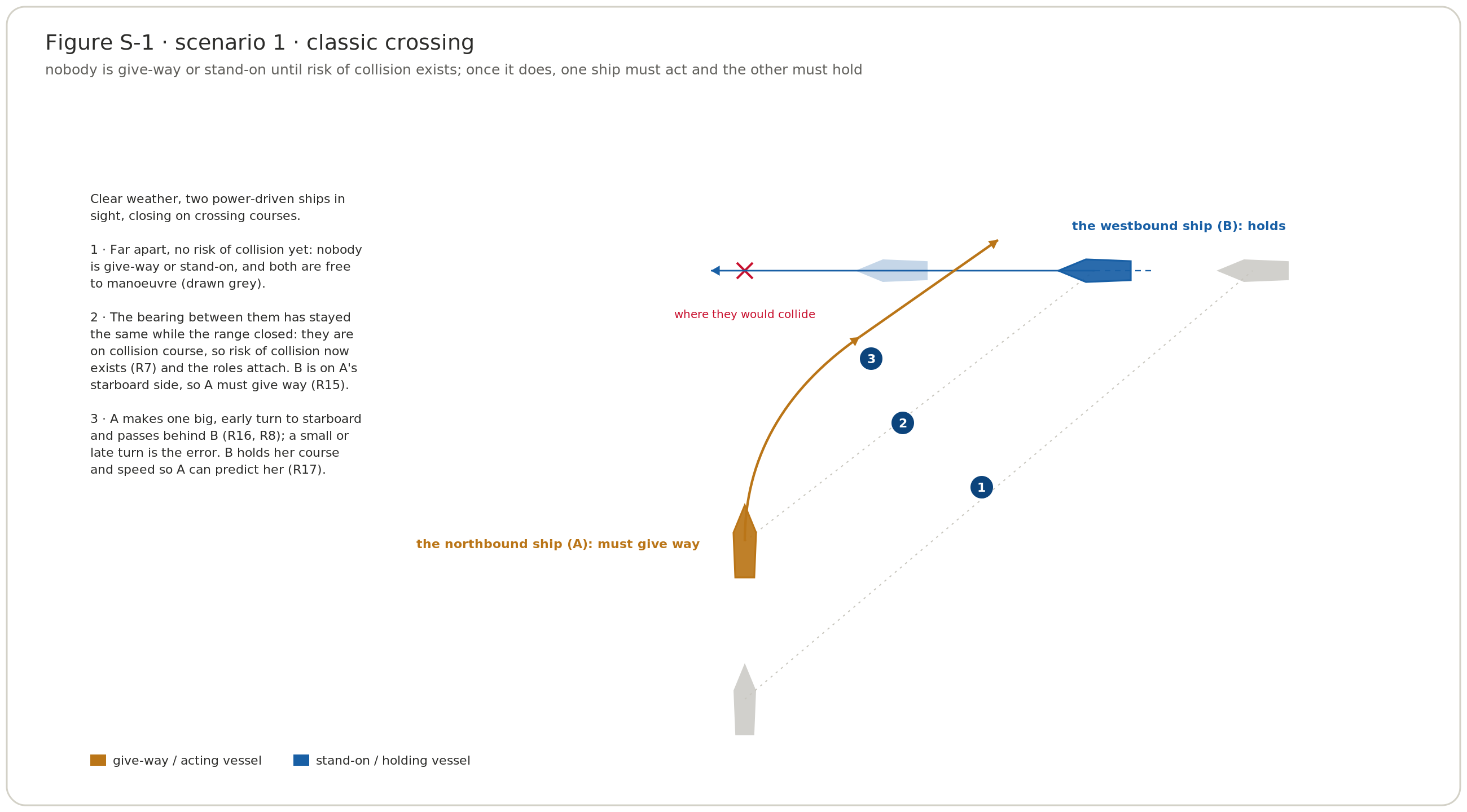
Figure S-1. Scenario 1: classic crossing. Nobody is give-way or stand-on until risk of collision exists; once it does, the northbound ship must act and the westbound ship must hold.
2: Head-on or crossing? (borderline angle)
Clear weather; two power-driven vessels closing nearly head-on, a few degrees off reciprocal, each showing the other both sidelights. In sight, Section II. The classification is genuinely ambiguous, and that ambiguity is itself the trigger: Rule 14(c) requires that, in any doubt, a head-on situation be assumed. Both alter to starboard for a port-to-port passing.
DRAFTING ISSUE: a split classification If A reads head-on and turns to starboard while B reads crossing (with A on her port side) and stands on, A’s turn increases separation and the result may be safe by luck, but B has breached Rule 14(c) by not assuming head-on in doubt; on these facts B bears the greater fault. Sea Star–Horta Barbosa (1976) is the warning.
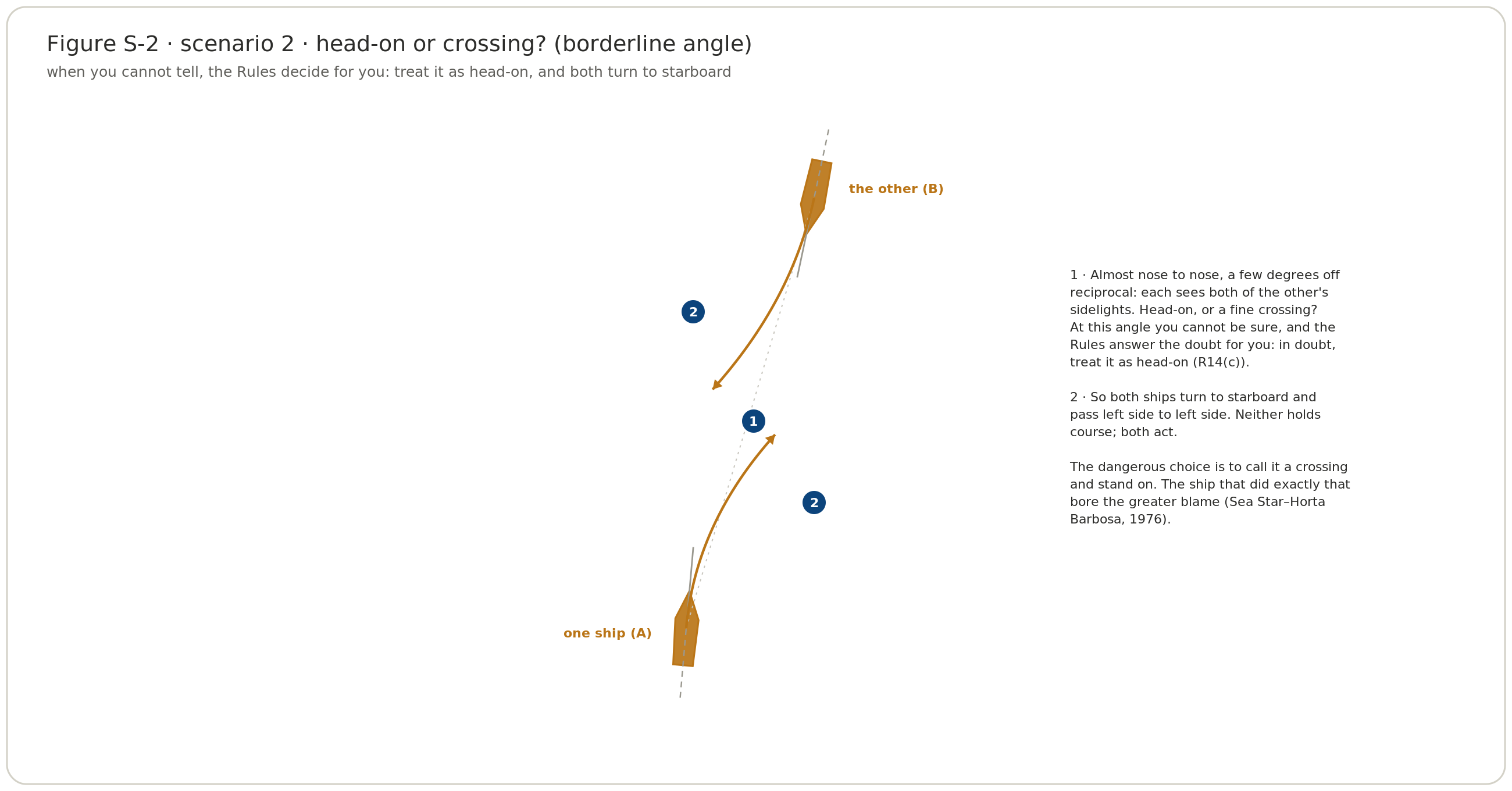
Figure S-2. Scenario 2: head-on or crossing? When you cannot tell, the Rules decide for you: treat it as head-on, and both turn to starboard (Rule 14(c)).
3: Long overtake with navigational need
A faster vessel A overtaking B from astern over a long stretch, B the stand-on vessel obliged to keep course and speed (Rule 17(a)(i)), but B is approaching a waypoint and needs to alter. In sight, Section II; Rule 13 governs and is locked by 13(d). The resolution is the Chapter 9 one: Rule 2(a) forbids B holding course into danger, Rule 13(d) keeps A burdened even if B alters, and Windsor–Roanoke (1908) confirms that “keep course and speed” is about predictability, not an absolute freeze.
PRACTICAL NOTE: communicate Though not required by the Rules, a VHF call from B telling A of the intended alteration turns a confusing change into a coordinated one; Rule 2’s ordinary practice of seamen supports using the radio to prevent a misunderstanding.
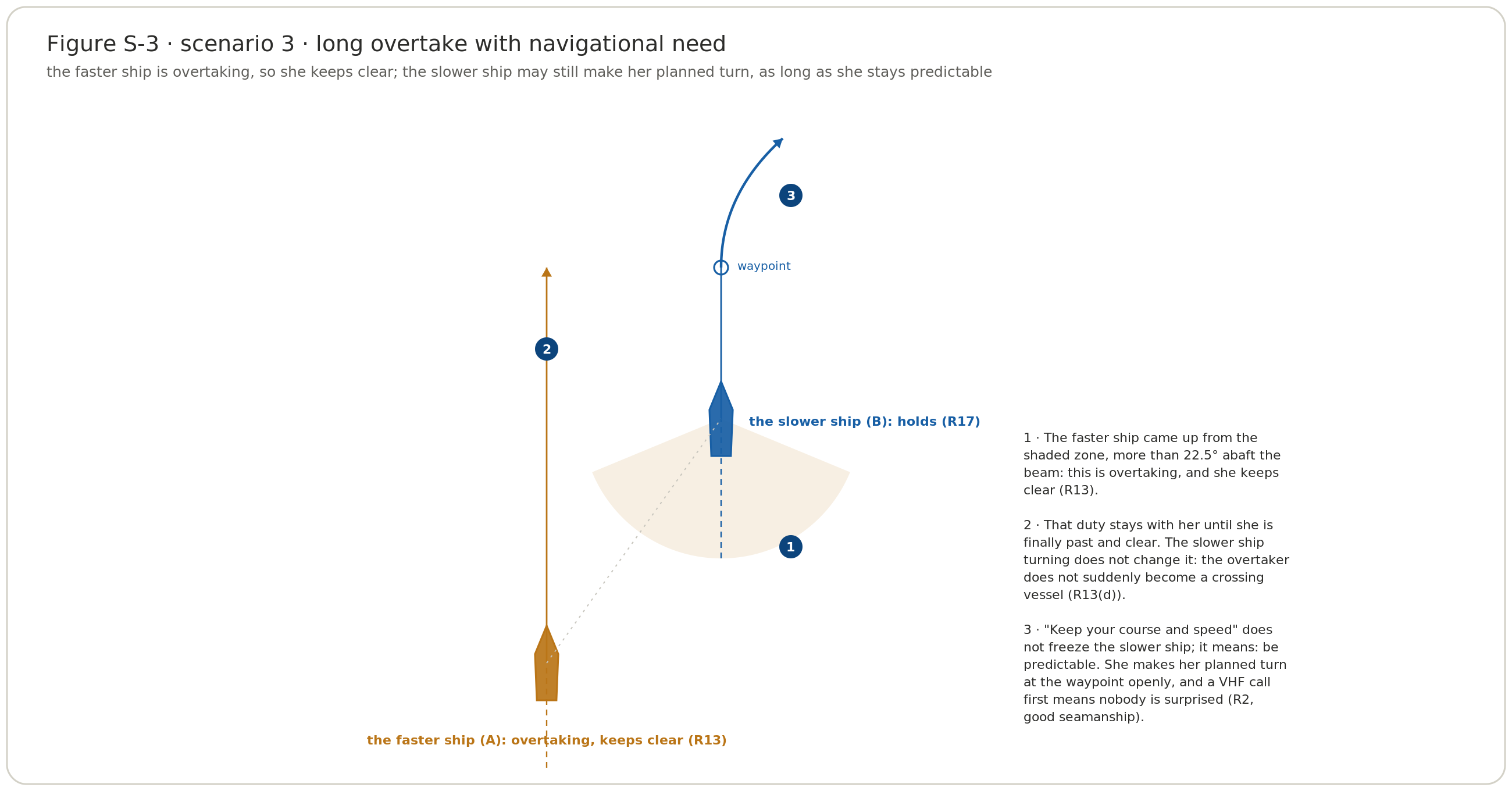
Figure S-3. Scenario 3: long overtake with navigational need. The faster ship is overtaking and keeps clear throughout (Rule 13(d)); the slower ship may still make her planned turn, predictably.
4: Emerging from fog (Rule 19 to Section II)
Restricted visibility; A holds B on radar fine on the port bow and, acting lawfully under Rule 19, alters to port. The fog then lifts and the two come into sight at close range. The instant visual contact is made, Section II applies, and A’s earlier port alteration may now put her in a crossing where she is give-way and badly placed.
DRAFTING ISSUE: no transition protocol A’s port turn was lawful under Rule 19; the moment the fog cleared it became a poor position under Rule 15, with no grace period in the text. This is exactly why Rule 19(d)(i) discourages port alterations for a vessel forward of the beam, to hedge against the sudden switch (Chapter 9).
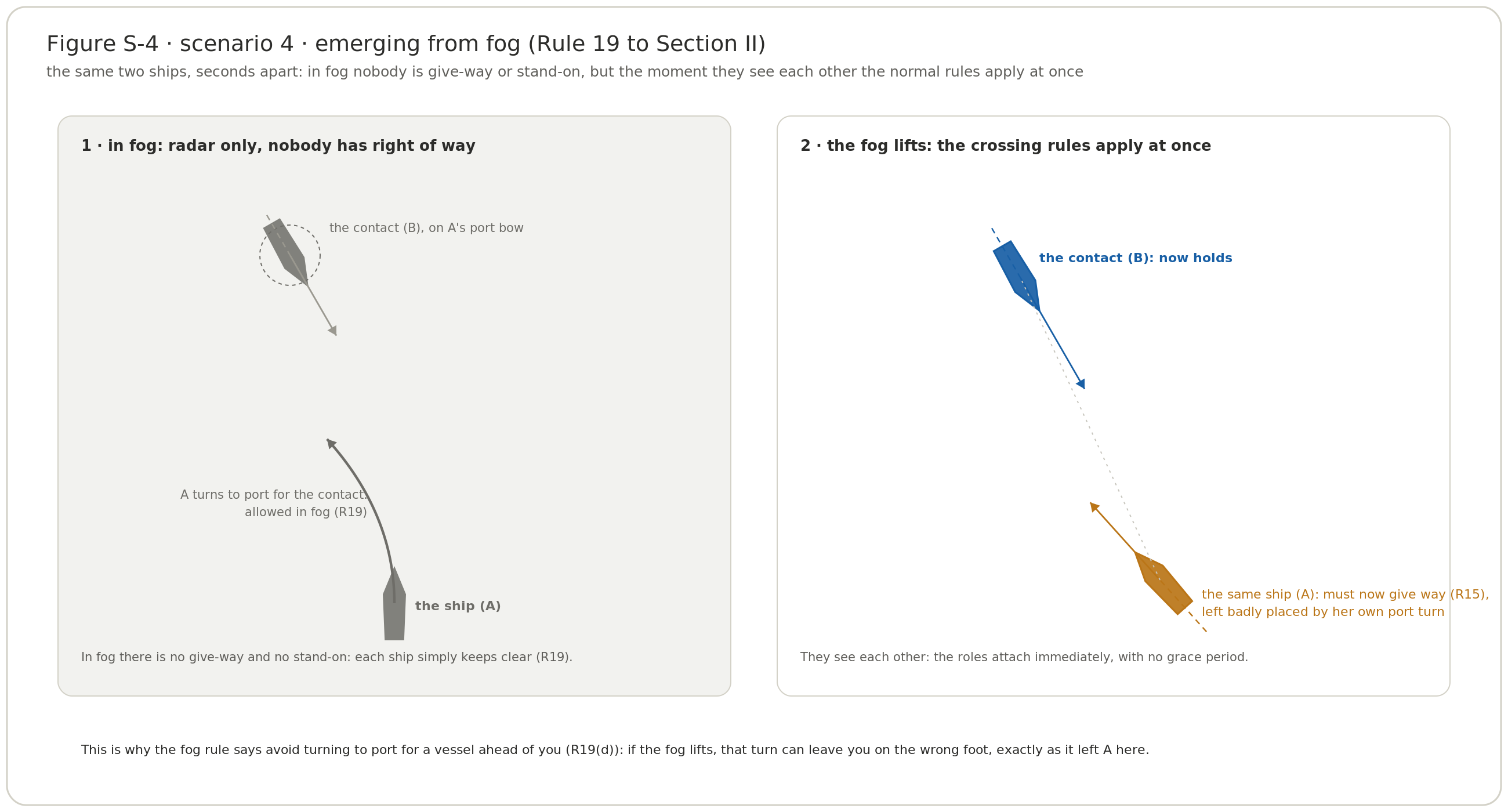
Figure S-4. Scenario 4: emerging from fog. The same two ships, seconds apart: no roles at all under Rule 19, then the fog lifts and the crossing rules apply at once.
5: Overtake completing, new crossing developing
A has overtaken B and is drawing ahead; the geometry begins to look like a crossing across B’s bow. Whether a fresh Rule 15 situation can start depends on whether risk of collision existed during the overtaking phase. If it did, Rule 13(d) holds A as the burdened overtaking vessel until finally past and clear. If the vessels were always going to pass well clear, a genuine crossing can develop afresh (Auriga–Manuel Campos, 1977).
PRACTICAL NOTE: patience The pull to alter the moment you draw ahead is strong, but altering before finally past and clear keeps the overtaking classification alive, and any resulting collision falls on the overtaking vessel whatever the geometry at impact.
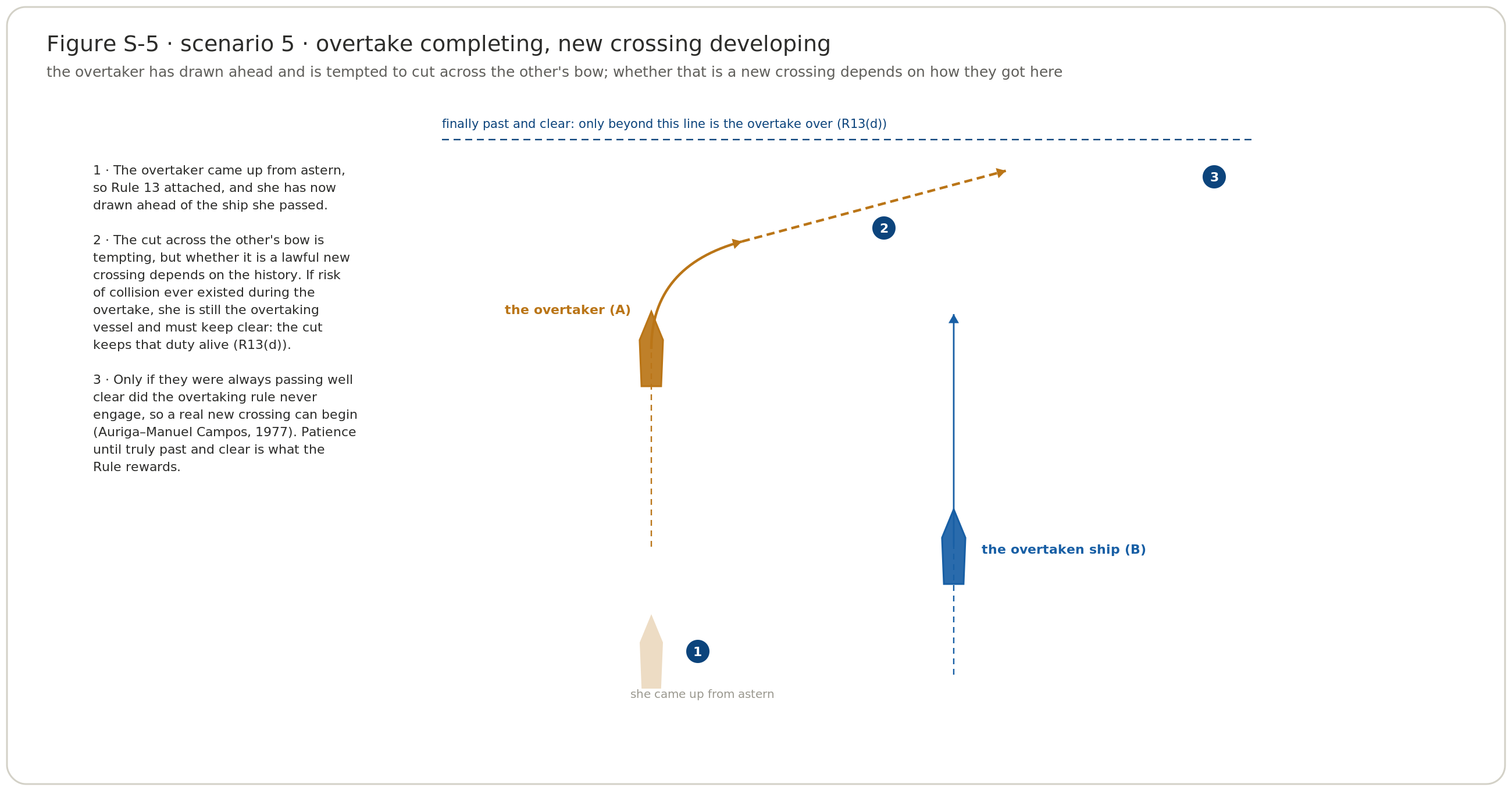
Figure S-5. Scenario 5: overtake completing. The tempting cut across the bow before finally past and clear: whether a new crossing can exist depends on the history, not the present picture.
6: Not-impede escalating to risk of collision
A small vessel C (under 20 metres) in a narrow channel is required not to impede D, a vessel that can navigate only within it (Rule 9(b)). C fails to keep clear in time and risk of collision develops. Now both frameworks apply (Rule 8(f)): C’s not-impede duty does not disappear, and the encounter Rules apply on top, so D may not simply hold on trusting C to move, she too must act.
PRACTICAL NOTE: the double burden The lesson of Rule 8(f): “not to be impeded” was never “right of way.” Once risk of collision exists both vessels are burdened, C for failing to keep clear and D for failing to act (Chapter 8).
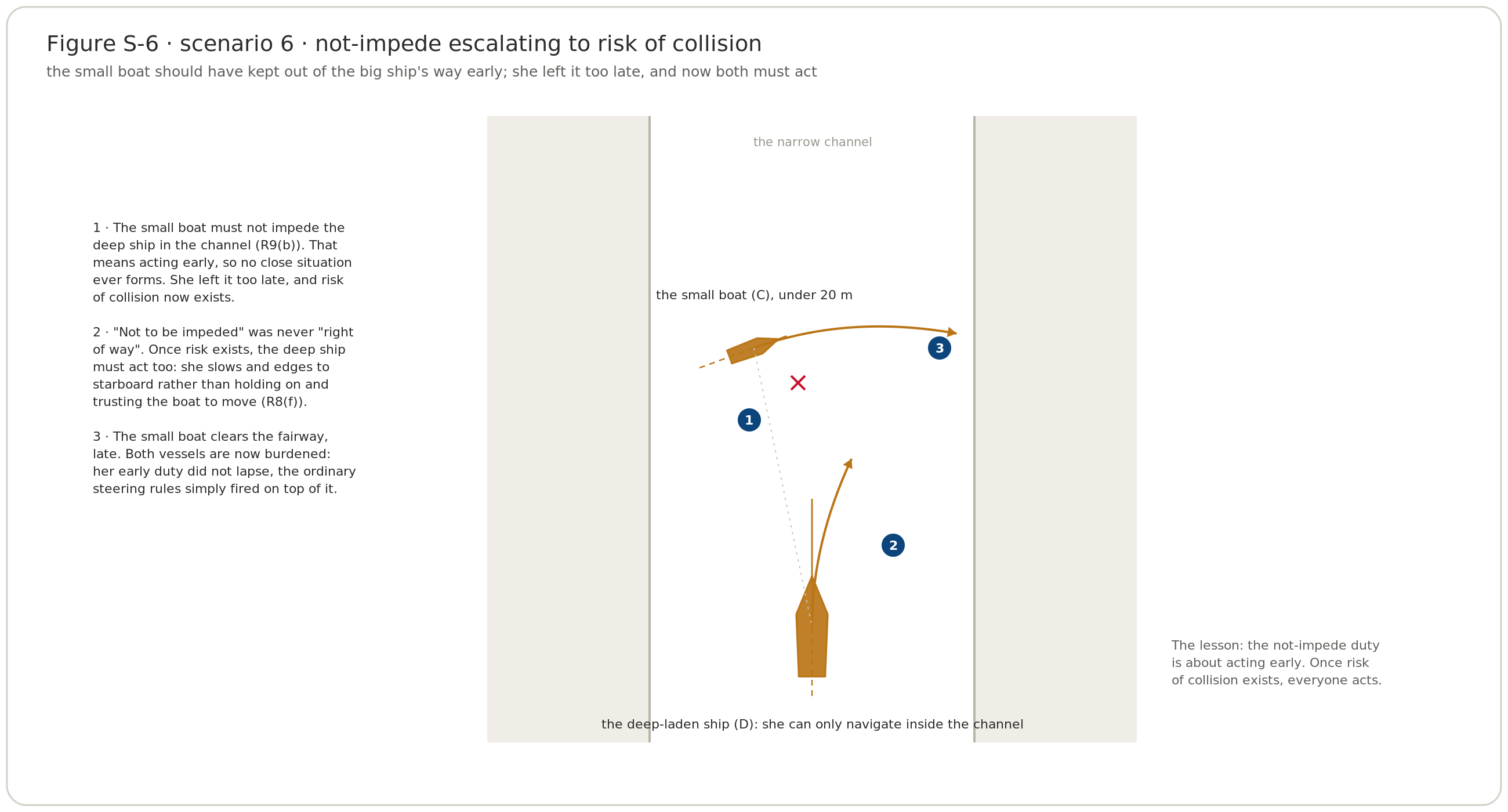
Figure S-6. Scenario 6: not-impede escalating to risk of collision. The small boat should have acted early; once risk of collision exists, both vessels are burdened (Rule 8(f)).
7: Narrow channel with a TSS and several vessel types
A constrained-by-her-draught tanker A in a channel that is also a TSS lane; a fishing vessel B and a sailing vessel C nearby. A’s safe passage is not to be impeded (Rules 9, 10, 18(d)); between B and C the Rule 18 order gives the fishing vessel priority over the sailing vessel. But if risk of collision develops between any pair, the encounter Rules apply in addition to the not-impede duties: no vessel is exempt from acting once collision threatens.
PRACTICAL NOTE: the practical hierarchy A sits at the top by virtue of the channel and the not-impede Rules, but recall from Chapter 7 that she is still a power-driven vessel, and an ordinary crossing can develop with her. The not-impede duties and the encounter Rules stack; they do not replace one another.
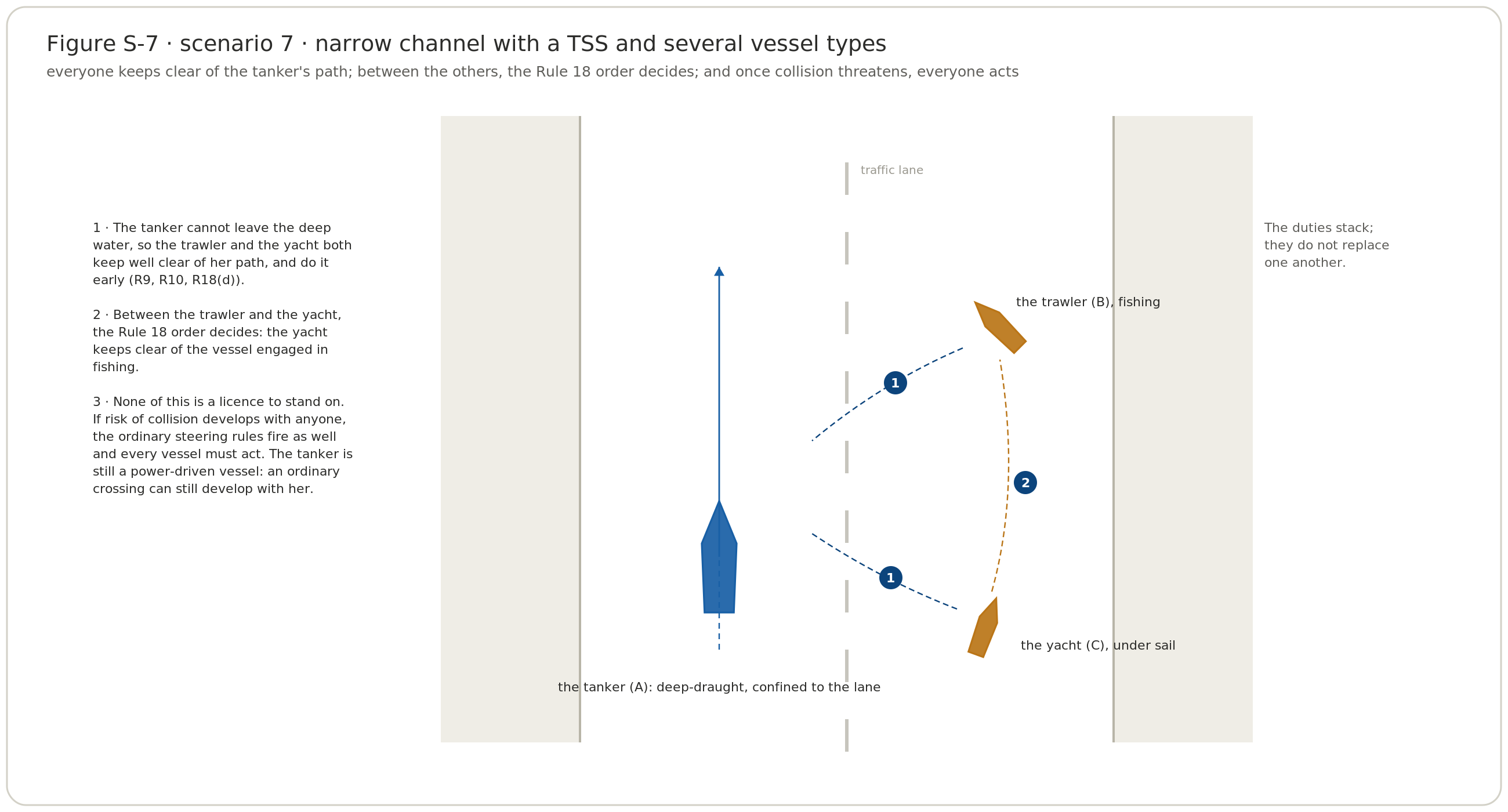
Figure S-7. Scenario 7: narrow channel with a TSS and several vessel types. Everyone keeps clear of the tanker’s path, the Rule 18 order decides between the others, and the duties stack rather than replace one another.
8: Rule 17 escalation: when does the stand-on act?
A crossing in which B is the stand-on vessel and A, the give-way vessel, does nothing. B holds course and speed (Stage 2). As it becomes apparent A is not acting, B may act on her own manoeuvre (Rule 17(a)(ii), Stage 3) and should sound five short blasts (Rule 34(d)). When A’s action alone can no longer avoid collision, B must act (Rule 17(b), Stage 4), and the port-turn restriction of 17(c) lifts.
DRAFTING ISSUE: the grey zone Between the permission of 17(a)(ii) and the duty of 17(b) lies the gap where most casualties occur. Act too early and B may confuse a late, large alteration by A; wait too long and B has no room. The Rules give no number for it; it is professional judgement, held to good seamanship (Chapters 8 and 9).
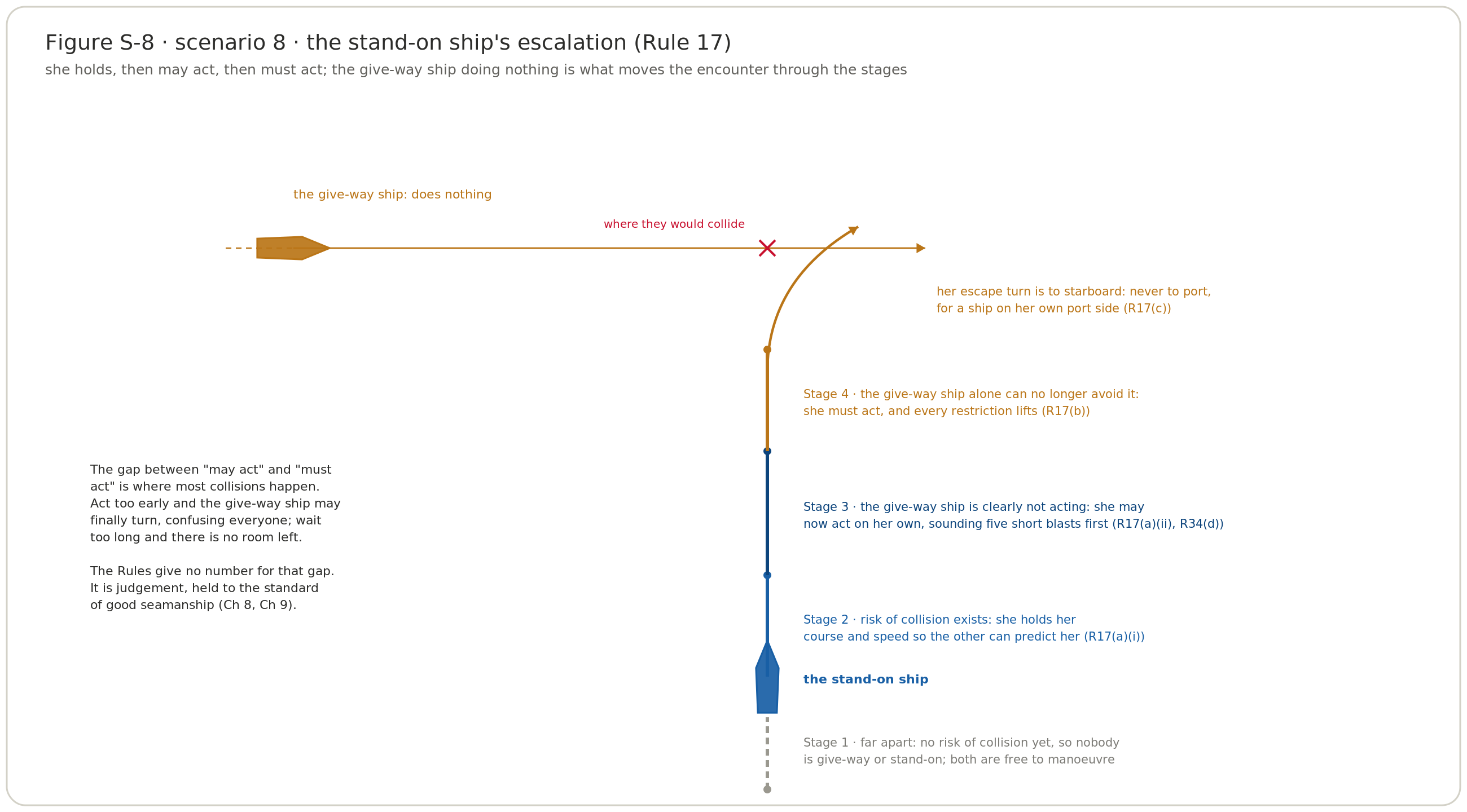
Figure S-8. Scenario 8: the stand-on ship’s escalation. The four stages mapped onto her track: she holds, then may act with five short blasts, then must act, with the escape turn to starboard (Rule 17).
9: Sailing vessel encounters (Rule 12)
Two sailing vessels. On opposite tacks, the port-tack vessel gives way to the starboard-tack vessel (12(a)(i)); the memory aid is that port wine is red and red means danger, so the port-tack vessel is burdened. On the same tack, the windward vessel gives way to the leeward (12(a)(ii)). And a port-tack vessel who cannot make out the other’s tack gives way (12(a)(iii)), the doubt provision again putting the conservative vessel in the give-way role.
PRACTICAL NOTE: Rule 13 still overrides If one sailing vessel is overtaking the other from more than 22.5 degrees abaft the beam, Rule 13’s “notwithstanding” overrides Rule 12 entirely and the overtaking vessel keeps clear regardless of tack.
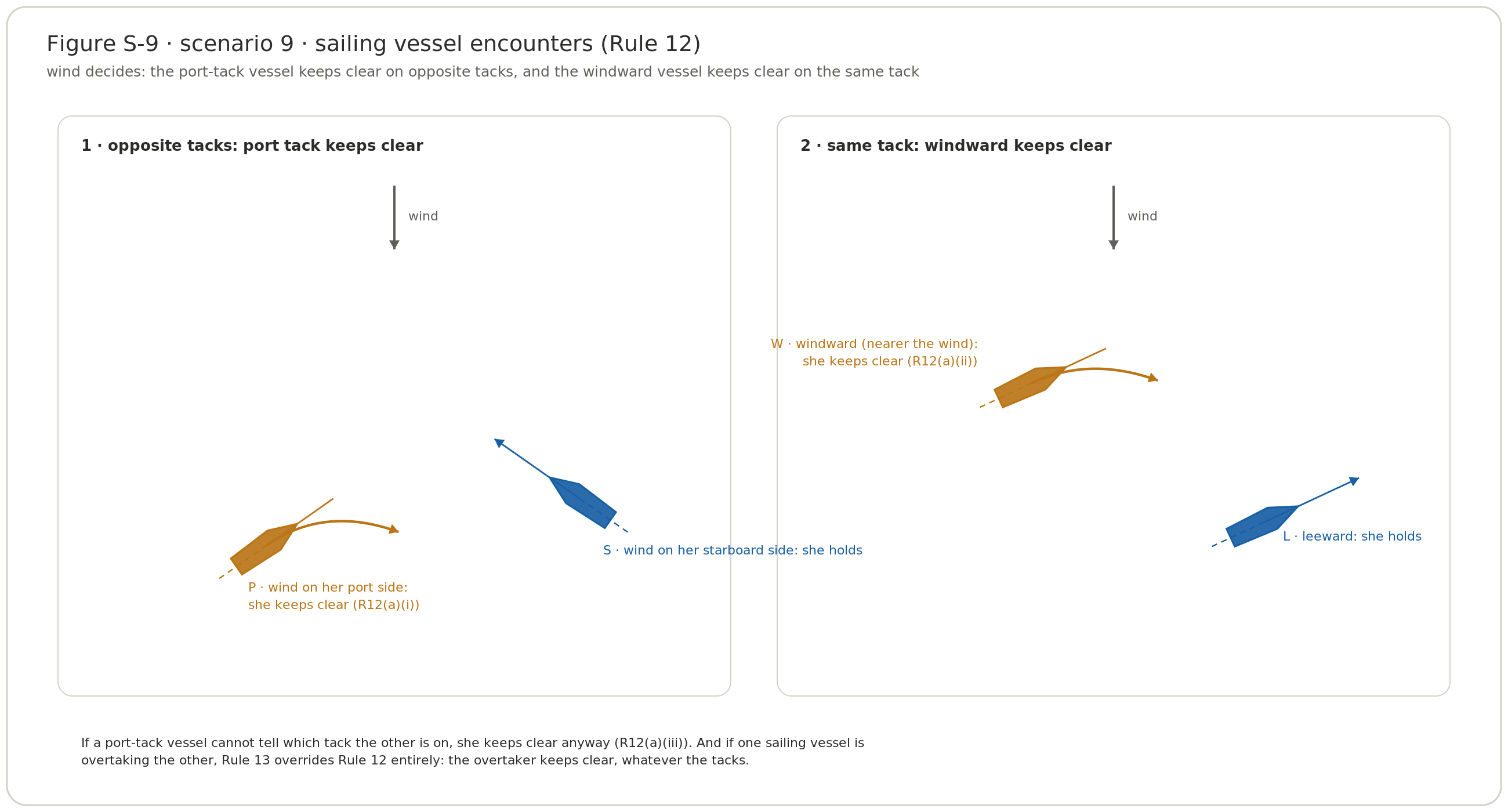
Figure S-9. Scenario 9: sailing vessel encounters. Wind decides under Rule 12: the port-tack vessel keeps clear on opposite tacks, the windward vessel on the same tack.
10: Restricted visibility: a radar-only encounter
Fog; A and B hold each other on radar only, neither in sight, on closing tracks with the other forward of the beam. Section III: Rule 19 governs, there is no stand-on or give-way vessel, and each acts independently. Each takes avoiding action in ample time, and by 19(d)(i) each avoids a port alteration for the forward contact.
PRACTICAL NOTE: why 19(d) works when both comply The directional restrictions are built so that two complying vessels’ actions agree: both altering to starboard for a forward contact produces a port-to-port passing, the same outcome as a head-on. The system fails only when one vessel breaks 19(d)(i) and turns to port while the other turns to starboard, which can put them on converging courses (Chapter 9).
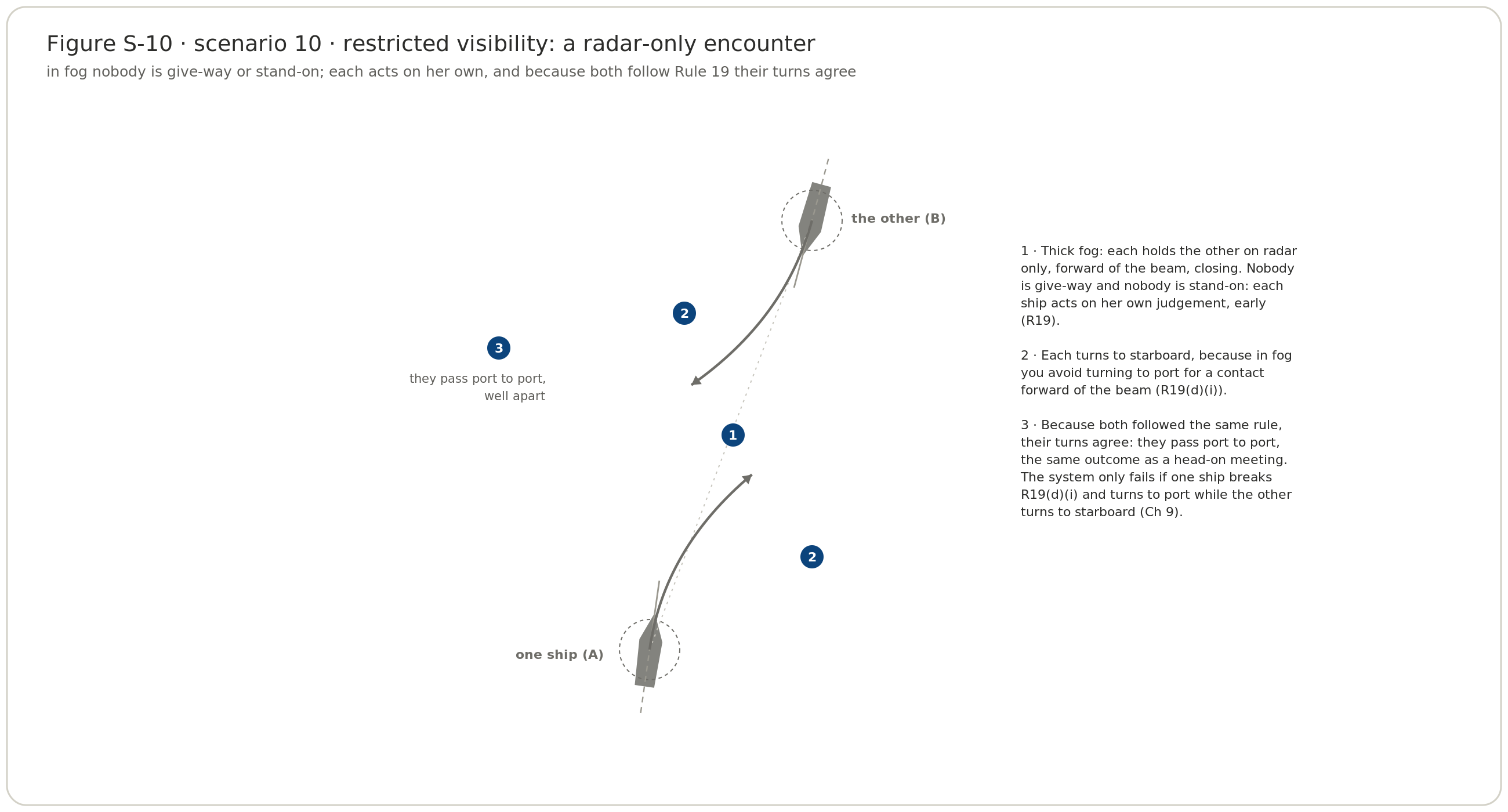
Figure S-10. Scenario 10: a radar-only encounter in fog. No roles under Rule 19, but two ships each following 19(d)(i) turn the same way and pass port to port.
11: The ghost overtaker (Rule 19 / Rule 13)
Fog; B is coming up on A from astern, held on radar only, more than 22.5 degrees abaft A’s beam. Because the vessels are not in sight, Rule 13 does not apply and there is no overtaking relationship in law; both act independently under Rule 19. The only nod to the geometry is the carve-out in 19(d)(i) that lets B alter to port for the vessel she is overtaking.
PRACTICAL NOTE: what if the fog clears? The instant visual contact is made, Section II applies and Rule 13 takes effect: B is now legally overtaking and keeps clear, A is stand-on. Here the switch works in everyone’s favour, because B already carried the closing obligation and the classification merely formalises it (Chapter 9, overtaking in restricted visibility).
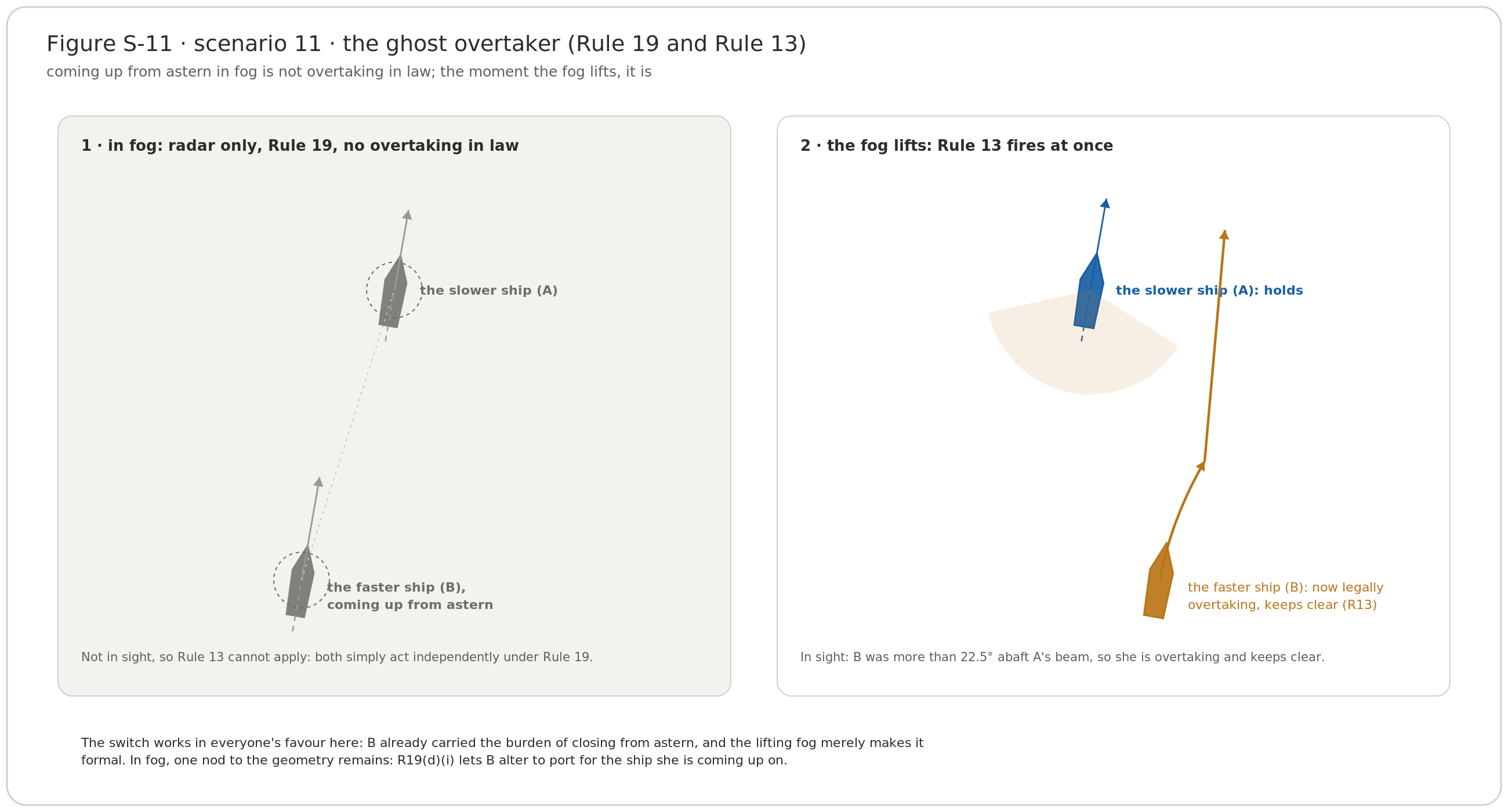
Figure S-11. Scenario 11: the ghost overtaker. Coming up from astern in fog is not overtaking in law; the moment the fog lifts, Rule 13 takes effect.
12: Naval: a task group meeting a merchant crossing
Clear weather; an RAN warship A stationed in a task group on a steady course and speed, a merchant ship M developing on a crossing bearing from the group’s starboard side. Toward her consorts A manoeuvres to tactical instruction; toward M she is simply a power-driven vessel in a crossing, with M on her starboard side, so A is the give-way vessel and owes M early and substantial action to keep clear, tactical station notwithstanding. Where keeping station and keeping the Rules conflict, the duty to avoid collision with the vessel outside the force governs and the tactical requirement yields (Chapter 4).
PRACTICAL NOTE: the warship under two systems ATP-1 organises the manoeuvring among the warships but has nothing to say about M and does not apply to her; toward M the plain COLREGs govern in full. Treating M as part of the tactical picture is the error that puts a warship in the wrong.
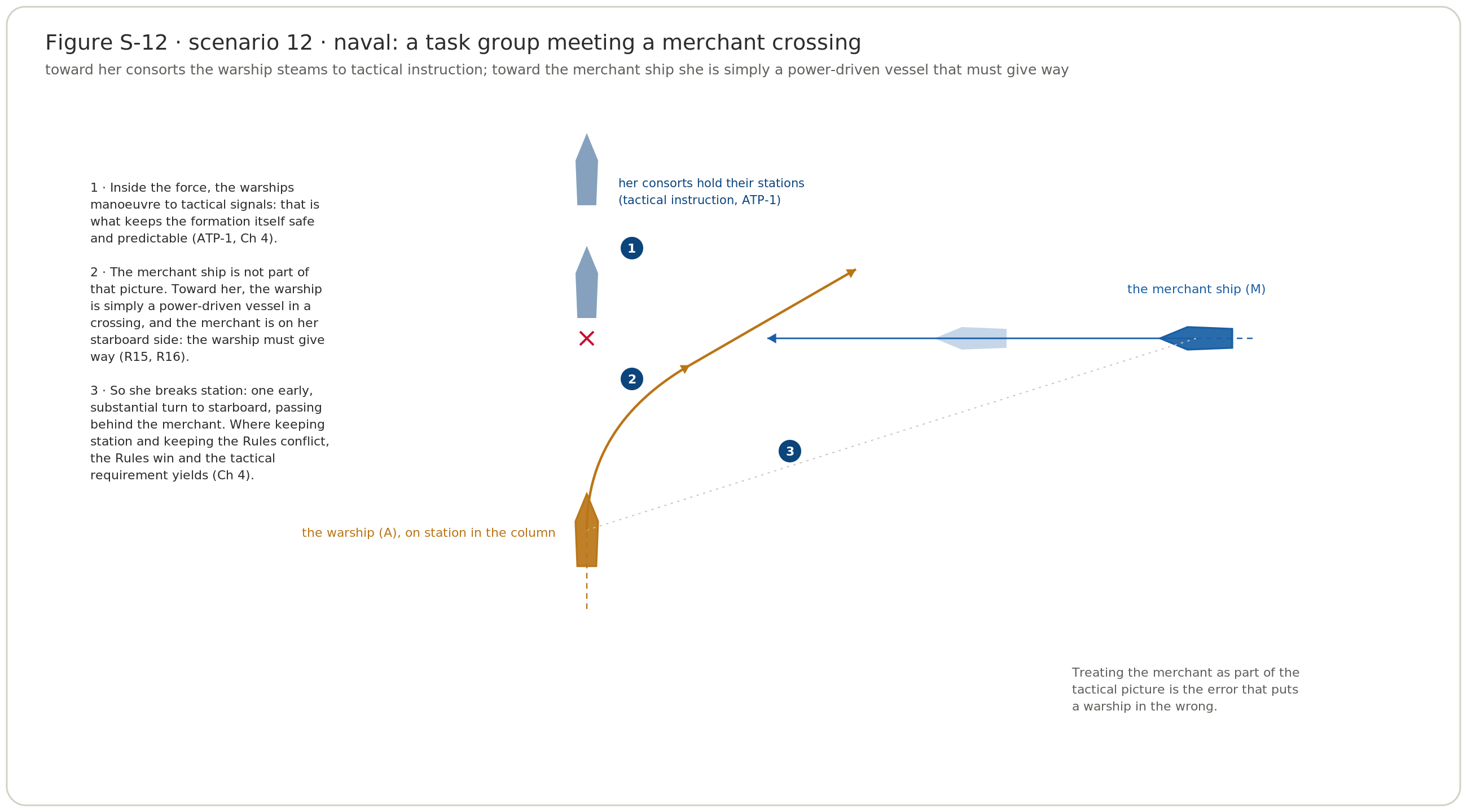
Figure S-12. Scenario 12: a task group meeting a merchant crossing. The consorts hold their tactical stations; toward the merchant the warship is simply give-way, and breaks station to pass astern.
13: Naval: a CUES unplanned encounter with a foreign warship
Open sea; an RAN warship A and a warship F of an unaligned navy meet unexpectedly on closing tracks, both in sight. Both are bound by the COLREGs exactly as any power-driven vessels: the encounter is resolved on its geometry under Section II, with Rules 14 or 15 as the aspect dictates. The allied tactical instructions do not bind F, so the supplementary layer is CUES, the voluntary Code for Unplanned Encounters at Sea (Chapter 4), which gives the two bridges a shared, non-binding vocabulary of manoeuvres and signals to make their intentions legible to one another. CUES sits alongside the Rules; it does not displace them.
PRACTICAL NOTE: predictability across an unfamiliar bridge CUES exists for exactly this gap, two professional bridges correct on the COLREGs but with no shared tactical language. It is the predictability principle (Chapter 1) reaching into the corner the binding Rules leave thin, and good seamanship under Rule 2 still governs throughout.
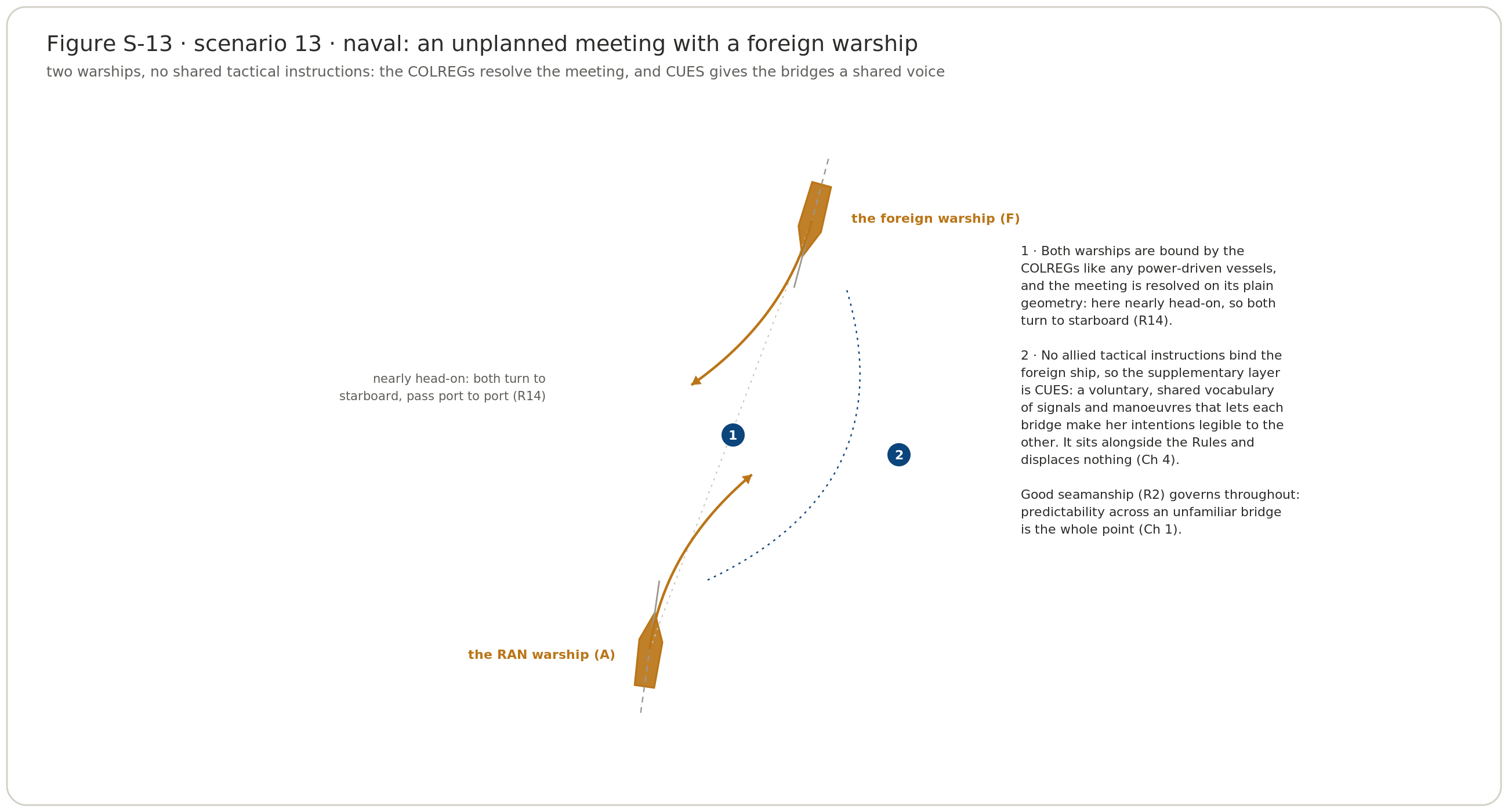
Figure S-13. Scenario 13: an unplanned meeting with a foreign warship. The COLREGs resolve the meeting on its geometry; CUES gives the two bridges a shared set of signals alongside the Rules.
Scenario index (for revision): crossing, 1, 7, 12; head-on, 2, 13; overtaking, 3, 5, 11; stand-on action (Rule 17), 8; give-way action (Rule 16), 1, 12; restricted visibility (Rule 19), 4, 10, 11; not-impede / narrow channel / TSS (Rules 8(f), 9, 10), 6, 7; sailing (Rule 12), 9; naval / CUES, 12, 13.